A team can have eight ad metrics on its scorecard and still not know whether an ad did its job. The fix is not to find a magic ninth metric. Define the advertising objective first, then choose the few creative criteria and the right evidence for the decision in front of you.
That decision is specific: What should this ad accomplish for this audience, and what would help us judge whether the creative is doing its part? An ad review can help assess qualities such as clarity, relevance or brand visibility. On its own, it cannot establish that an ad will drive sales or improve ROAS.

Start with the decision, not the scorecard
Advertising objectives give creative review a direction. Before looking at scores or choosing an edit, identify the audience, the task the ad is meant to perform and the decision the team needs to make.
A business goal might be growth in a category. An advertising objective describes the ad’s intended contribution, such as introducing a product to a defined audience or encouraging people to consider an offer. A creative success criterion turns that objective into a question the team can assess: Can viewers understand what the product does? Is the brand connected to the message? Is the next step clear?
Platform campaign-objective labels can help guide campaign setup, but they are not the same thing as a brand’s strategic objective or a creative success criterion. Keep the review focused on what the ad should communicate or prompt for its audience.
An ad can be strong in one way and weak in another. Viewers might enjoy a video without understanding its offer. A striking execution might attract attention without making the advertiser memorable. Those are possibilities to investigate, not automatic relationships or guaranteed outcomes.
How should advertising objectives shape creative success criteria?
The same video may need to meet several goals, but a review still needs a primary question. Otherwise, a team risks treating every metric as equally important and every weakness as a reason to start over.
Awareness: Will people notice and connect the ad to the brand?
For an awareness objective, ask whether the ad earns attention, whether the brand is identifiable and whether the idea is distinctive or memorable in a way that connects to the brand. Attention is a useful question, especially for a format viewers can skip. But attention alone does not show that people noticed who was speaking or will remember the brand later.
Look at how the brand appears throughout the ad, not only in the end card. Consider whether the central visual or story helps viewers identify the advertiser, and whether the final moment directs attention toward the brand or elsewhere. These are review prompts, not a formula for awareness.
Channel guidance can add useful context, but keep it channel-specific. For example, Google Ads’ video creative guidance is relevant when planning for Google Ads video placements. Do not automatically apply any platform’s advice to every format or channel.
Consideration: Is there a clear, relevant reason to think about the offer?
For consideration, focus on whether viewers can understand the offer, whether it feels relevant to their needs and whether the ad gives them a reason to consider the brand. A creative review can ask whether the message is understandable and persuasive. It cannot establish that a viewer will eventually buy.
Keep comprehension and persuasion distinct. A viewer may understand what a product does without finding a reason to choose it. A strong-sounding claim may also fail if people cannot tell what it means in practice. The review should help uncover which question needs attention.
New product or feature: Can the audience grasp what it is and why it matters?
When introducing a product or feature, make understanding central. Can the intended audience explain what is new, what it does and why that benefit might matter to them? Is the brand visibly connected to the explanation?
A creative review can flag an unclear product demonstration, an unexplained feature name or a benefit that arrives too late to make sense of the story. Audience research, if appropriate and enabled, can help answer a defined question about how a specified audience interprets the ad. Neither a clear explanation nor a positive response proves that the product will sell.
Direct response: Is the offer and next action understandable?
For a response-oriented objective, ask whether the offer is clear, whether the ad gives a reason to act and whether the intended next step is understandable. The live response, such as conversions or another campaign outcome, must be measured in the campaign and interpreted in light of its setup.
A creative review can identify friction in the message or call to action. It does not predict campaign results with certainty. Actual performance depends on more than the creative, and a pre-launch diagnostic is not a substitute for in-market measurement.
These objectives can overlap. A launch ad may need to explain a product and build awareness; a response ad may also strengthen brand affinity. The team still needs to state which decision has priority in this review. If the answer is “all of them,” prioritisation is not finished.
Choose a few measures that answer the question
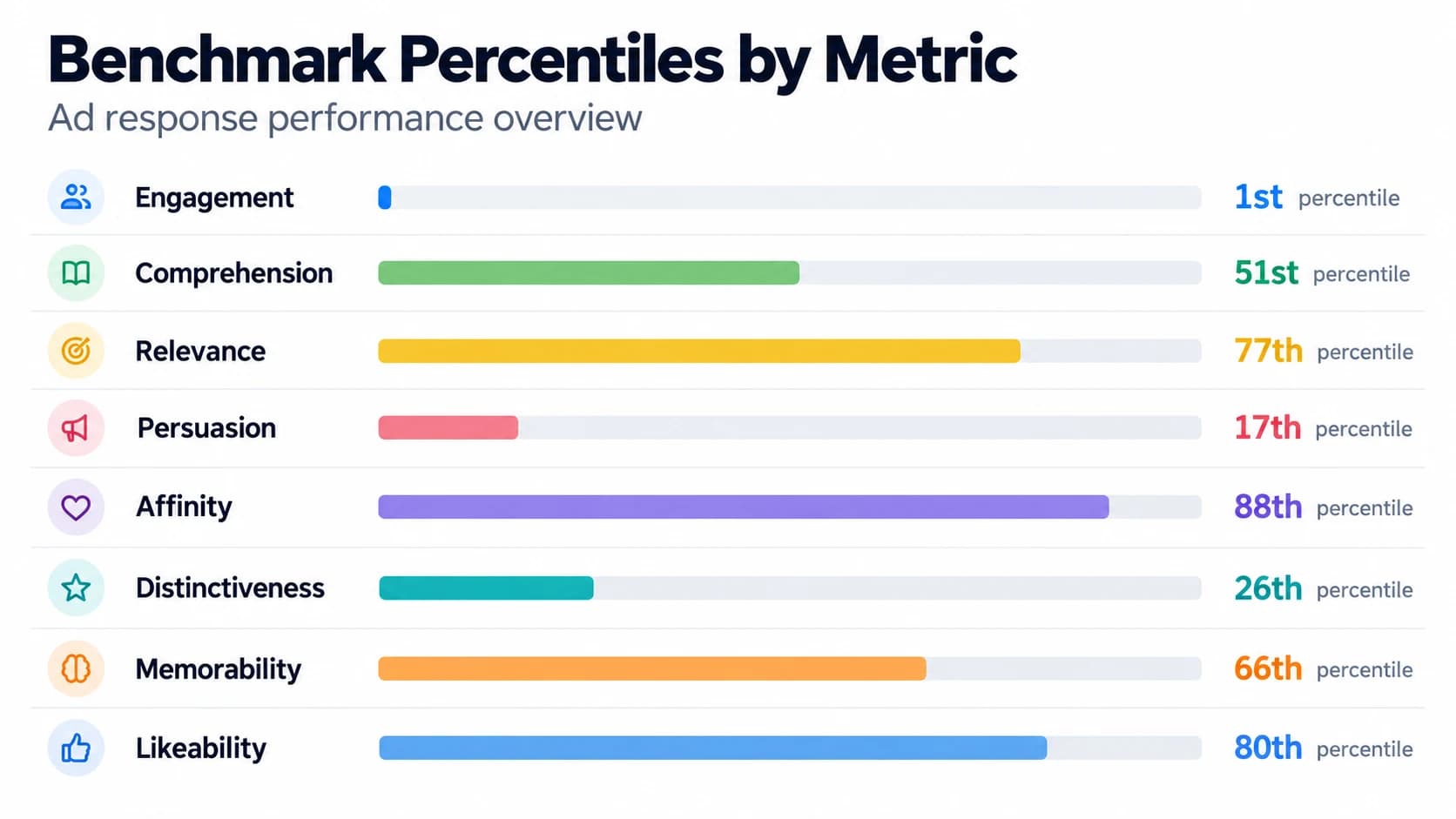
Eight dimensions can help a team describe different aspects of an ad: engagement, comprehension, relevance, persuasion, affinity, distinctiveness, memorability and likeability. They are not eight interchangeable votes on whether an ad is “good.”
- Engagement asks whether the ad captures and sustains attention.
- Comprehension asks whether viewers can make sense of the story and message.
- Relevance asks whether the message connects with viewers’ needs or lives.
- Persuasion asks whether the ad gives viewers a reason to choose or act.
- Affinity asks whether it builds a favorable connection with the brand.
- Distinctiveness asks whether it stands out from other advertising and remains recognisable.
- Memorability asks what viewers may retain about the ad, brand or message.
- Likeability asks whether viewers respond favorably to the ad itself.
As Sumit Saxena of Merren advises, teams cannot optimise for all eight at once. Choose a small primary set based on the objective. Use other observations to diagnose a concern or shape a potential edit.
For a new-product explanation, comprehension and relevance may be central questions. For awareness, brand connection and memorability may deserve more attention. These are starting points for a review, not universal metric prescriptions. The right choices depend on what the team needs to decide and what the available evidence can answer.
Keep the evidence types separate, too. A structured creative review provides diagnostic observations. Model-derived diagnostics are not participant responses. Enabled participant evidence can address a specified audience question, within the limits of that study. A live campaign experiment addresses an in-market outcome under its own design. Each has a different job. The MIRA methodology describes distinctions between model-derived diagnostics and participant evidence. The NIST guide to choosing an experimental design provides useful context for matching an experiment to a question.
A practical workflow for setting advertising goals
Use this sequence before approving a video ad or asking a team to choose between variants:
- Name the audience and context. Specify who the ad is for and what they are likely to know already. “Consumers” is rarely enough to make a useful creative decision.
- Write the primary objective. Describe what the ad should help the audience understand, remember, consider or do. Keep it to one main task for this review.
- Name the decision. Are you deciding whether to approve the concept, clarify the product benefit, change the opening or compare two executions? A useful review answers a real next-step question.
- Choose a few creative criteria. Select the dimensions most relevant to the objective. Add a diagnostic criterion only when it helps explain a concern, not because the scorecard has space for it.
- Choose evidence that fits the question. A creative audit, model-derived diagnostic, audience study and live campaign test do not answer the same thing. Define the evidence you need before interpreting results.
- Set a fair comparison. Specify which versions or benchmark set you are comparing and why that comparison helps. A comparison provides context; on its own, it does not establish a cause or prove business impact.
- Record limits and the next step. State what the evidence cannot establish. Then decide whether to approve, edit, gather audience evidence or run a properly designed campaign test.
For video, practical review prompts may include the value communicated in the opening, whether the payoff supports the promise, whether the message can be expressed in one sentence, how the brand is integrated, whether the duration fits the idea and whether a celebrity or other focal element supports or distracts from the message. These are questions to investigate, not proven recipes for performance. If testing a live campaign, define the outcome and comparison carefully. Google Ads’ experiments guidance offers platform-specific context, not a universal testing rule.
A fill-in template for the creative brief
Use this short template before a review. It can sit alongside a broader creative brief. For more background on brief-writing, see Asana’s creative brief resource.
- Audience and context: ___
- Primary advertising objective: ___
- What the viewer should understand, remember or do: ___
- The decision this review will inform: ___
- Two or three creative criteria to prioritise: ___
- Evidence type and comparison: ___
- What this evidence cannot establish: ___
- Next edit, research question or campaign test: ___
Which advertising objective is a specific example?
For a hypothetical launch video, a specific objective could be helping the intended audience understand what the new product does and why it may be relevant to them. This is an illustration, not a result or universal recommendation. It becomes more useful when the team names the audience, the product benefit and the decision the review must inform.
Hypothetical example: reviewing a launch video
Imagine a consumer brand preparing a video to introduce a new home device. The team’s primary objective is to help its intended audience understand what the device does and why it may be useful. The review should begin there, not with a general request to “make the ad stronger.”
The team might ask: Does the opening establish a problem the audience recognises? Is the product’s function visible or otherwise clear? Does the story connect the function to a benefit? Can viewers tell which brand is making the offer? Does the ending make the next step understandable?
If the product’s role is unclear, the team could consider a revision that demonstrates the function earlier. That is a hypothesis to evaluate, not a guaranteed improvement. The next step might be a structured review of the revised version or audience research designed to answer whether the intended audience understands the offer.
Now change the objective. If the same video is primarily for awareness, the team may put more emphasis on attention and whether the idea connects to the brand. If it is intended to prompt an immediate response, the offer and next action may become more central. Those changes do not make the other criteria irrelevant; they change which questions lead the decision. No scores or campaign outcome can be inferred from this hypothetical example.
Common mistakes and limits to keep in view
Choosing metrics before the objective. A large scorecard can create the appearance of rigor while leaving the actual decision unanswered. Start with the task, then choose measures.
Treating one positive signal as proof of another. Likeability is not the same as comprehension. Attention is not proof of brand connection. A strong creative assessment is not proof of sales, incremental conversions or ROAS.
Trying to optimise everything. When every dimension is a priority, trade-offs stay hidden. Choose a primary objective and a short set of criteria, then make the tension explicit.
Confusing diagnostic and outcome evidence. A model-derived observation, a participant response and a live campaign result have different sources and limits. Do not present one as if it measured another.
Using a benchmark without checking its fit. Comparing variants, a team’s own ads, an overall pool or a pre-selected set can help provide context. The comparison set still needs to fit the decision, and a benchmark does not establish causation or predict campaign performance. Ask whether the set is relevant and state its limits.
MIRA can support ad selection, editing and improvement, variant comparison, and benchmarking against a team’s own ads, an overall pool or a pre-selected set. Those capabilities can inform creative decisions; they are not a guarantee or forecast of ROAS. Keep any follow-up campaign test and business outcome measurement distinct from pre-launch creative review.
The takeaway
Write the advertising objective before opening the scorecard. Choose a few criteria that help answer the decision, and use evidence appropriate to that question. Then make the next step explicit: approve, edit, learn from the intended audience or test an in-market outcome.
To explore how MIRA can help your team select, edit and improve ads, compare variants and benchmark creative, visit MIRA.