An ad can hold attention and still leave viewers unsure what is being offered. The offer can be clear while the brand goes unnoticed. So what deserves approval? Criteria tied to the ad’s job. Use other measures to diagnose what may need work, then use campaign KPIs to assess what happens in market.
An ad creative evaluation checklist should help a team make a specific decision, not certify a winner. The practical distinction is between approval gates, creative diagnostics, and later campaign outcomes. Treating those as interchangeable is how a lively review ends with a score but no useful next step.
Start with the job the ad needs to do
Before reviewing the video, write down its objective and intended audience. Is the ad meant to build awareness, introduce a product or feature, or prompt a response? Who needs to understand it? What should that person notice, understand, remember, or do?
Those questions make good creative more concrete. A product introduction may need to explain what the product does and why it matters. An awareness ad may need to connect the brand with something viewers can remember. A response-focused ad may need to give its intended audience a relevant reason to act. Those jobs call for different approval criteria. They are examples, not a universal taxonomy.
Sumit Saxena of Merren makes a useful point in his objective-led review guidance: choose measures that answer the question the ad is meant to answer. Do not try to optimize all eight creative metrics at once. A metric is not useful just because it is available.
The brief should name the audience and desired response, not just the objective label. Awareness, for example, still leaves a team to decide what people should notice or remember, and whether connecting that memory to the brand is part of the job. If reviewers cannot answer those questions, clarify the brief before debating the edit.
Separate approval gates, diagnostics, and campaign KPIs
A review can do three different jobs: decide whether an ad is ready, identify what might need revision, and set up how to assess campaign outcomes after launch. Keeping those jobs distinct makes it easier to see what the evidence supports.
Approval gates are requirements the ad must meet before it is approved for its intended use. A team might decide that viewers need to understand the offer, or that the brand must be identifiable. The brief determines which requirements matter. There is no universal checklist that makes every item a pass-or-fail rule for every ad. Write each gate so a reviewer can check it, and be clear about what would cause the team to hold the ad.
Creative diagnostics help reviewers understand what may be working or what might need revision. Sumit’s framework includes engagement, comprehension, relevance, persuasion, affinity, distinctiveness, memorability, and likeability. These address different questions. Choose the ones that matter for the objective instead of turning them into one score for goodness. A diagnostic can point to a question worth resolving; it does not automatically become an approval gate.
Campaign KPIs are the outcomes a team uses to assess performance after launch. Choose them for the campaign objective and evaluate them with an appropriate comparison. A pre-launch creative review can inform a decision, but it cannot stand in for a campaign result or guarantee one. Experimental design should fit the question being asked, as NIST’s guidance on choosing an experimental design explains. For a campaign experiment, Google Ads’ guide to experiments describes comparing campaign changes with an original campaign. Neither source establishes that a particular creative will succeed.
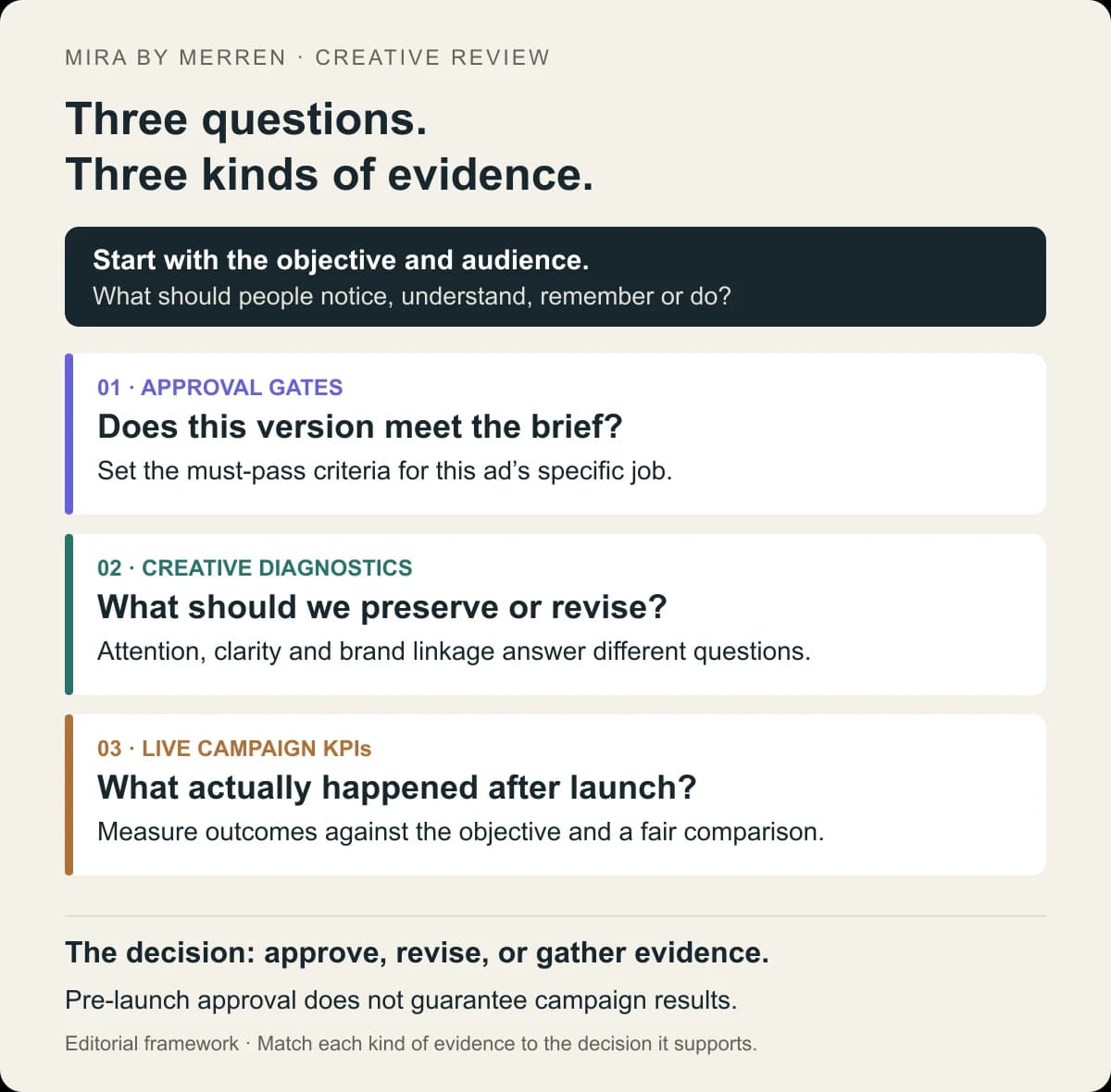
Why are attention, comprehension, brand linkage, and persuasion different?
Attention asks whether the ad captures or sustains notice. Comprehension asks whether viewers can make sense of its story, offer, or main message. Brand linkage asks whether they connect the content or message to the brand. Persuasion asks whether the ad offers a reason to choose or act. These are separate questions, and answering one does not settle the others.
An ad may draw attention without explaining the offer. A viewer may understand the offer without remembering which brand made it. A viewer may like the ad without receiving a reason to act. These are possibilities to examine, not measured findings about any particular video.
The distinctions matter because a team can approve an ad for doing one thing well when the brief requires something else. Strong attention does not prove comprehension; comprehension does not prove persuasion; and none of these judgments establishes a campaign outcome. Decide which questions matter before reviewing the scores.
An editable ad creative evaluation checklist
Copy the table into a review document and adapt the decision column to the brief. Some prompts can become approval gates; others are diagnostics. Campaign KPIs belong in the follow-up plan, where they can be assessed against live outcomes. There is no need to force every row into a score. A note about what the reviewer saw, what remains uncertain, and what should happen next is often more useful than a number without context.
| Review area | Question to ask | Gate, diagnostic, or later KPI? | Evidence or reviewer note | Decision / next edit |
|---|---|---|---|---|
| Objective and audience | Is the ad’s intended job and audience written down? | Approval gate for the review | Record the briefed objective and audience. | Clarify the brief, or continue. |
| Opening and attention | Does the opening give the intended viewer a reason to stay, especially in a skippable format? | Diagnostic; a gate only if the brief makes it one | Note the opening moment and the basis for the judgment. | Keep, revise, or seek audience evidence. |
| Comprehension | Can viewers make sense of the offer, product, or main message? | Often a gate when understanding is essential; also a diagnostic | Record what reviewers understood and where they hesitated. | Clarify the message, or continue. |
| Brand linkage | Is the brand present early enough and given enough coverage for this objective? Where might attention fall, including in the final shot? | Diagnostic; may inform a brief-specific gate | Note brand appearances and any possible visibility issue. | Adjust timing, prominence, or the final shot if needed. |
| Persuasion | If the ad is meant to prompt action, does it offer the intended viewer a relevant reason to choose or act? | Diagnostic; later outcomes are campaign KPIs | Record the reason offered and any unresolved question. | Strengthen the reason, or define what to assess in market. |
| Relevance and affinity | Does the message connect to the intended audience’s needs or build the kind of brand connection the objective calls for? | Diagnostics | Record the basis for the judgment; distinguish reviewer impressions from audience evidence. | Keep, revise, or gather appropriate evidence. |
| Distinctiveness and memorability | Is the creative recognizable, and what should viewers retain: the ad, brand, or message? | Diagnostics | State what should be distinctive or remembered. Ad memory and brand memory are different. | Make the intended memory cue clearer if needed. |
| Likeability | Do viewers respond favorably to the ad itself, and does that matter to this objective? | Diagnostic | Liking the ad does not establish persuasion or brand preference. | Keep it in perspective; do not use it as a proxy for the objective. |
| Featured person or celebrity | Does the person support attention and the brand or message, or might the person distract from them? | Diagnostic | Describe the possible contribution or distraction; do not assume an effect. | Keep, adjust the role, or review the brand connection again. |
| Decision and follow-up | Is the decision approve, revise, or gather more evidence? What drives it? | Approval decision; live outcomes are later KPIs | Record uncertainty, the creative version, and the next question. | Name the next edit or campaign comparison. |
For each row, note whether the input comes from reviewer inspection, participant evidence, or a live campaign outcome. Those evidence types answer different questions. A reviewer’s observation can flag a possible issue; it does not prove how an audience will respond. If a decision depends on information the review cannot provide, record the uncertainty and decide whether to gather relevant evidence or proceed with a clearly stated limitation.
A hypothetical video-ad review
Consider a hypothetical 20-second video introducing a new home-delivery service. The objective is to introduce the service to people who may need it and make the basic offer understandable. This example is illustrative. It describes no real campaign and predicts no results.
The team first sets its gates. Viewers should be able to identify what the service offers, and the brand should be connected to that offer. The team then uses attention and comprehension as diagnostics. Does the opening give the intended viewer a reason to watch? After viewing, can reviewers explain the service in their own words? If the team uses an audience study to answer that second question, it should record the result as participant evidence, separate from reviewer impressions.
Now imagine the opening is amusing, but the service and its benefit become clear only in the final moments. The opening may seem to do its attention job, while the comprehension review points to a problem. Both observations can be true. The team might keep the opening and introduce the service sooner, then review the revised version. It should also check whether the brand appears where the message lands, including in the final shot. That is a useful review prompt, not a guarantee that moving a logo will improve outcomes.
The checklist helps make the revision specific. “The ad needs work” is not an edit. “Introduce the service earlier, then check whether viewers can explain the offer and connect it to the brand” is a more useful next step. If reviewers disagree about what the ad says, record that disagreement. It may indicate ambiguity, or it may show that the team needs evidence from the intended audience before making the call.
Change the objective and the emphasis changes too. For awareness, the team may give more weight to whether viewers can connect the brand with a distinctive, memorable message. For a response-focused ad, it may focus on whether the video offers a relevant reason to act, then assess the chosen campaign outcomes after launch. These are ways to match the review to the brief, not claims that one creative measure predicts another.
The review should end in a clear decision: approve the version, revise a named element, or gather evidence to resolve a particular uncertainty. A good score alone does not explain why the team should proceed.
Common evaluation mistakes and evidence limits
Trying to optimize every metric can make a decision less clear. Eight metrics may look comprehensive, but they can become eight competing objectives. Choose the measures that matter for the ad’s job. Keep other observations as context rather than turning them into competing approval targets. Each criterion should have a reason to be there.
Attention can be useful, especially when a format lets viewers skip. It does not establish that they understood the message, connected it to the brand, or were persuaded. Ask the next question instead of assuming the answer.
Likeability and persuasion are different judgments. A viewer may enjoy an ad without receiving a reason to choose or act. A clear message is not automatically persuasive either. Keep each judgment tied to the question it can answer.
A structured review can expose confusing moments and suggest edits. Participant evidence can answer specified audience questions. A live campaign comparison evaluates defined campaign outcomes. Modelled diagnostics, participant evidence, creative review, and campaign experiments are different forms of evidence. MIRA’s methodology and evidence guidance describes these boundaries. Check the method and measures used for a specific report rather than assuming every output answers every question.
A checklist can help a team select or improve creative and decide what to examine next. It cannot guarantee ROAS or provide certainty about campaign performance. Live outcomes need their own definitions and an appropriate comparison. Keep the creative version and review rationale so a later campaign test can answer a useful question.
If a celebrity or another prominent personality appears, ask whether the role supports attention and the brand or message, or might distract from them. Sumit’s guidance identifies this as a useful review question. It does not establish that using a celebrity will produce a particular effect.
Turn the review into a practical decision
A useful review can be brief if each step leads to a decision:
- Write down the objective and intended audience.
- Choose approval gates that follow from the brief.
- Select diagnostics that help assess those gates and the ad’s job.
- Record what each judgment is based on, along with what remains uncertain.
- Decide whether to approve, revise a specific element, or gather more evidence.
- If the ad goes live, define the campaign outcome and comparison needed to assess it.
A pre-launch review can narrow the question for a later campaign test. It does not replace that evaluation. The NIST and Google Ads resources above can help teams think about matching experimental comparisons to their questions. They do not show that any particular review process guarantees an outcome.
Approve against the ad’s job
Start with what the ad must do. Set gates that follow from the brief, use diagnostics to decide what to preserve or improve, and assess campaign outcomes with live evidence. Attention, comprehension, brand linkage, and persuasion each tell the team something different.
MIRA by Merren helps teams improve ROAS by selecting, editing, and improving ads, comparing variants, and benchmarking against their own ads, the overall ad pool, or a pre-selected set. These capabilities can support creative decisions; they do not guarantee campaign results. Explore MIRA.