An AI tool flags two ads as different. That is useful, but it does not tell your team whether viewers noticed the difference, whether one ad is more persuasive or whether either will improve campaign results.
That is the practical challenge with AI market research for advertising: tools can help teams organize creative, identify features to review, compare variants and form research questions. What an output establishes depends on its inputs, method and supporting evidence. A modelled prediction is not a measured audience response, and neither is a campaign outcome.
Start with the decision you need to make. Then check whether the tool’s evidence can answer that question.
What does AI market research mean for an ad team?
For an ad team, AI market research means using AI-supported methods to inform decisions about advertising: which creative to review, what to edit, how variants differ or what needs further investigation. It covers different tasks, and those tasks produce different kinds of answers. A tool might organize assets, transcribe speech, code visible features, summarize supplied studies or generate model-based predictions.
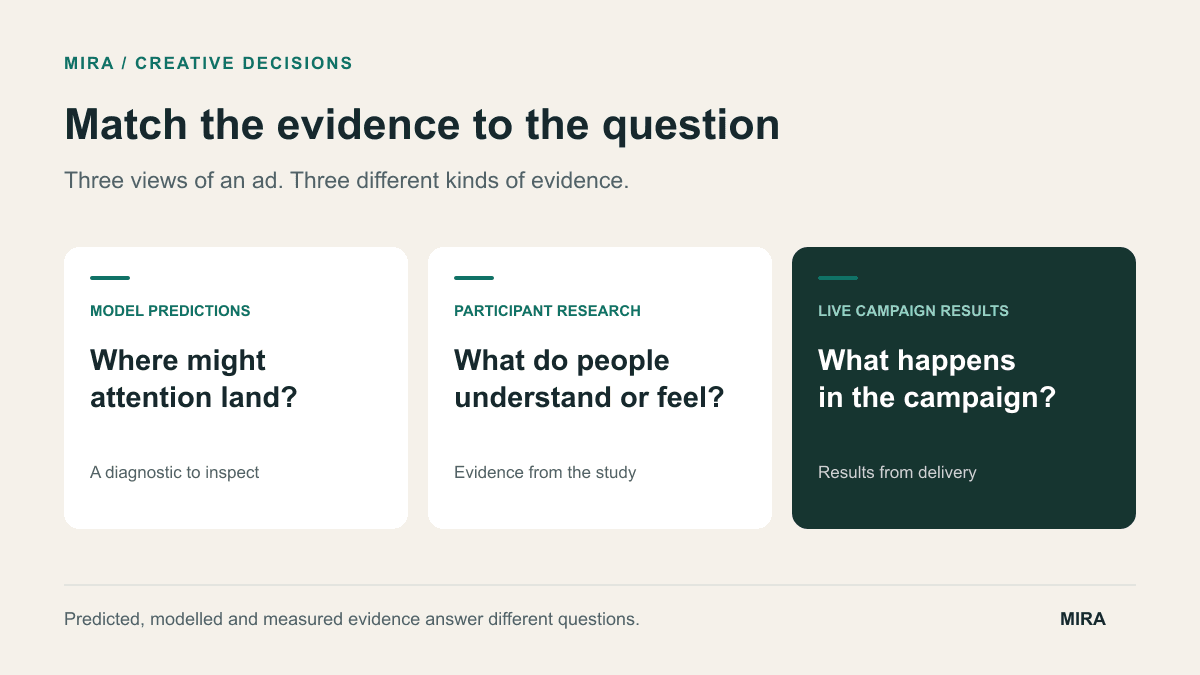
A detected product shot is an observation about the creative, subject to detection error. A score predicting a response is a model output. A participant’s answer in a defined study is human response data. A campaign’s sales or ROAS is an outcome in a particular market and delivery context. These categories should not be treated as interchangeable.
AI can support ad research, but “the AI says this ad is better” is not a complete research conclusion. Better for what? Based on which evidence? Compared with what?
Start with the decision, not the AI tool
Before reviewing dashboards or asking for a score, write down the decision in one sentence. Are you selecting an ad, editing a scene, comparing two variants, choosing a benchmark or deciding whether you need audience research?
Then name the outcome that matters to that decision. If the issue is whether people understand an offer, a general creative score may not resolve it. If the concern is whether an ad’s message connects to the right brand, attention alone may not answer it. The right evidence depends on the question.
Consider a hypothetical team choosing whether to make a product benefit more explicit. It could use AI to identify where the benefit appears in a video or compare the wording across versions. Those observations may help the team decide what to inspect. But if the real question is whether the intended audience understands the benefit, the team needs evidence that addresses comprehension, not just an automatically generated summary or a broad prediction.
Write the decision first. Otherwise, a tool can deliver a polished answer to a question nobody needed answered.
Where can AI support ad research?
AI can help at several points in an ad-research workflow. Not every system offers every capability, and each task calls for a different follow-up check.
A system can help find and organize creative or locate assets that meet specified criteria. Check that the relevant versions, formats and source material are included. A tidy library is useful, but it is not evidence that the ads work.
AI can also help transcribe or code creative by identifying spoken words or visible elements for review. A detected brand cue, product shot or scene is a lead to verify against the actual ad. It does not establish that viewers noticed or remembered it. False detections and missed details matter when they could change the decision.
Some tools summarize supplied research. That can help a team navigate existing notes, interviews or reports, but the summary inherits the limits of those materials. Check important claims against the original evidence, especially when a qualified observation has become a confident-sounding generalization.
AI-supported analysis can help teams compare variants and develop hypotheses. It may make differences easier to inspect or suggest questions for the next round. The team still needs to know what was compared, what the output represents and whether the method has been evaluated for this use.
A model may also predict a possible response. That prediction is an inference, not a recording of what a participant thought. When supported for the intended use, it may help prioritize a review. It should not be presented as audience testimony.
Generated audience comments have the same limitation. A sentence written in the voice of a shopper is not a shopper. Synthetic answers can help a team brainstorm questions. They do not become sampled participant data because they sound plausible.
Four kinds of evidence that answer different questions
When AI is part of the research process, label the output before interpreting it. Four distinctions help prevent common leaps.
1. Observed or coded creative features
This is a claim about what appears in the supplied material: a phrase, scene, product, person or other feature. It can support an asset review or help a team find creative to inspect. By itself, it does not say what an audience noticed or how the feature affected response. Verify questionable detections against the ad.
2. Modelled predictions
A model predicts an outcome from inputs and a method. Ask what target it predicts, what data and model version were used, and how the prediction was evaluated. A prediction of a creative response is not a participant recording, a causal explanation or a forecast of ROAS unless evidence specifically supports that interpretation.
MIRA distinguishes modelled creative analysis from participant evidence. Its Creative Strength, Brain Mapping and predicted attention are modelled outputs. Separate participant workflows are a different evidence type. Check the method and model version recorded in the report, and confirm which study measures are enabled before commissioning research. MIRA’s methodology and evidence page describes these boundaries.
3. Participant evidence
Participant research collects responses from people through a defined method. Interpretation depends on who took part, what they saw, what they were asked and which measures were collected. It can address audience response in ways an unvalidated model prediction cannot. It does not automatically represent every audience, context or campaign.
4. Campaign outcomes
Sales, conversions and ROAS are observed in a live campaign under particular conditions. An ad-analysis output alone does not establish that it caused a business result. Delivery, audience, offer and measurement choices belong to the wider context. Keep creative diagnostics and campaign reporting connected, but do not label one as the other.
Ask what a number measures and whether that is the evidence your decision requires. A scientific-looking score cannot answer those questions by itself.
How to evaluate an AI ad-research tool before trusting its output
A sensible tool review traces how an output was produced and what it supports. Use this checklist:
- Define the decision. What will the team select, change, compare or investigate if the output is useful?
- Record the input and output type. Did the system receive the final ad, a transcript, metadata or something else? Is the result a coded observation, prediction, summary or participant evidence?
- Check the method and provenance. Ask which model or method produced the result and whether its version is recorded. Without enough context, a result is difficult to interpret or revisit.
- Find the target and comparison. What outcome was assessed, against what baseline and on which material? Similarity between inputs does not prove that a creative feature caused a response.
- Inspect validation and errors. Was performance checked on material separate from development? What can the system miss or misread? Does the evidence come from the context where your team plans to use it?
- Choose the next confirmation. Decide whether to check the ad, review existing research, collect participant responses or run a live test.
MIRA Ad Bank Analysis offers an example of why these questions matter. The July 27, 2026 exploratory driver screen covered 589 ads. A separate driver comparison built on 471 ads and validated on 118 did not meet its promotion criteria for added features. In the September 8, 2026 human-code replication, a selected model comparison reported a holdout Spearman correlation of 0.606, pairwise accuracy of 0.710 and mean absolute error of 0.685 z. The analysis explicitly reused a holdout and called for fresh labelled confirmation before deployment.
Those figures describe evidence about human-rated Creative Strength: whether an ad is clear, interesting and memorable. They do not measure sales, incremental conversions, delayed recall or campaign ROAS. The ad bank is a selected corpus, not a representative census of advertising. These findings can inform how a team thinks about validation; they do not establish that an ad will perform or that a model is ready for every use. Development evidence and fresh confirmation answer different questions. One may show that a result is worth investigating; the other is needed before relying on it for a new decision.
For broader guidance, NIST’s AI Risk Management Framework and its guidance on validity and reliability emphasize evaluating AI in context. Evidence from one target, corpus or setting does not automatically transfer to another.
A practical workflow: turn an AI observation into a testable next step
Here is a hypothetical workflow for a team with several possible edits to an ad. It assumes no outcome.
First, state the decision. For example: “Which edit should we review first to make the product benefit clearer?” That is more actionable than “Which ad is best?”
Next, use AI for a defined task. The team might organize versions, compare their wording or flag where the benefit appears. Keep the request narrow enough that someone can check the output.
Then inspect the source material. Does the flagged wording appear in the right scene? Did the tool miss a relevant version or infer a feature that is not there? Mark uncertainty instead of smoothing it away.
Turn the observation into a question or an edit. A possible hypothesis might be: “Moving this explanation earlier could make the benefit easier to follow.” That is a hypothesis, not a finding about how viewers will respond.
Choose a fair comparison. Compare variants against a benchmark that fits the decision: the team’s own ads, a broader pool or a pre-selected set. Check that the comparison is relevant and that the versions differ in ways the team can interpret.
Finally, match confirmation to the stakes. If the decision depends on what an audience understands or how it responds, use suitable participant research or a live test when earlier evidence cannot answer the question. Do not turn a model-generated observation into a conclusion without the evidence to support that step.
The tradeoff: faster review, without automatic certainty
AI may help teams review more material consistently or find candidates to inspect. Speed is useful when the output stays attached to its limitations. A missed scene, uncertain brand recognition, incomplete input or unsuitable comparison can send a confident recommendation in the wrong direction. These are risks to check, not proof that every tool fails in the same way.
Human review has a specific job: check whether the system read the creative correctly, whether its output matches the business decision and whether the evidence is strong enough for the next step. It should happen before the team settles on a score, not as a ceremonial approval afterward.
More research is warranted when the question concerns audience interpretation that a model has not measured; when the tool’s evidence does not cover the intended use; or when a consequential claim needs independent confirmation. NIST’s guidance on validity and reliability is a reminder to assess evidence in context rather than borrowing confidence from an unrelated test.
Where MIRA fits in AI-assisted ad research
MIRA by Merren helps teams improve ROAS by selecting, editing and improving ads, comparing variants, and benchmarking against their own ads, the overall ad pool or a pre-selected set. This is a broad product promise, not a guaranteed result, a campaign ROAS forecast or evidence that one model output proves an ad will win.
Start with the decision: what are you trying to select, edit or compare, and what benchmark would make the comparison meaningful? Then review MIRA’s product information alongside its methodology to distinguish modelled diagnostics from any enabled participant workflow. A benchmark can frame a decision, but the team still needs to ask whether the evidence fits.
Make the output earn its place
AI market research is most useful when a team knows which decision it supports, checks what the output represents and confirms important conclusions with suitable evidence. Write down the decision, the evidence it requires and the benchmark that would make a comparison useful. Then choose the tool or human study that can answer the question. A score is a starting point only when you know what it scored.