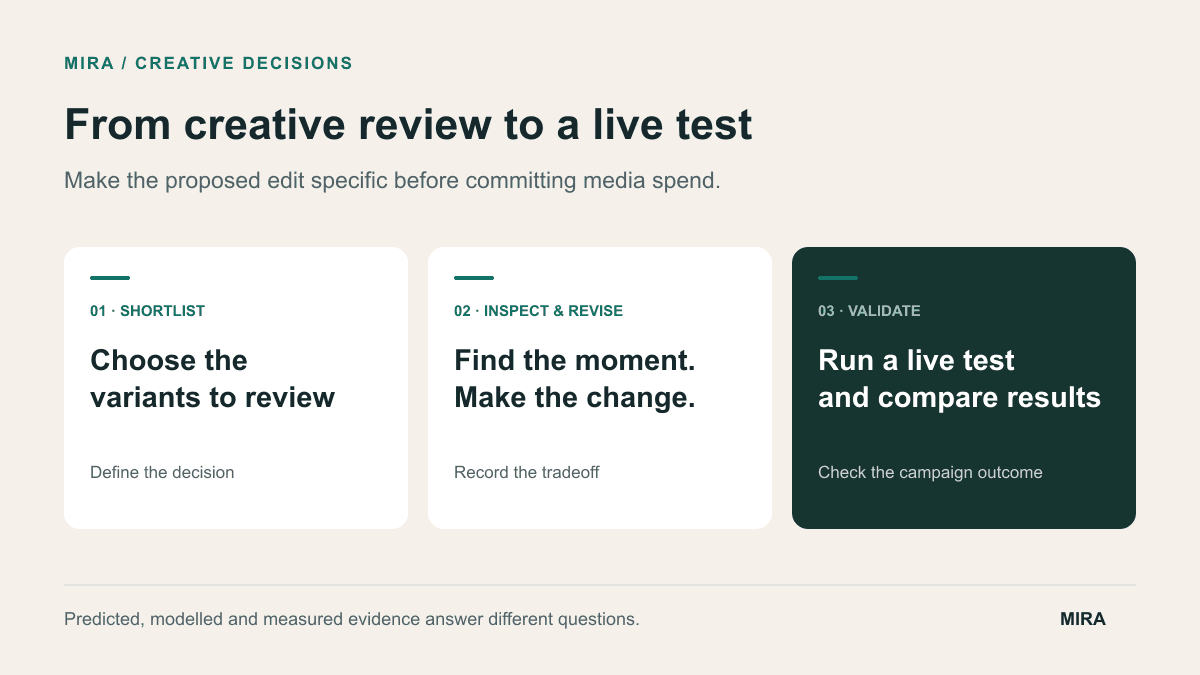
An ad can catch someone’s attention and still leave its offer unclear. To test ad creatives on Meta before spending, define what the ad needs to do, choose a few review questions that fit that objective, and compare variants with a relevant benchmark. The review can produce a shortlist and editing priorities—not a prediction of campaign performance. A live campaign is still needed to learn how the ads perform.
Define the decision before reviewing the ads
Sumit Saxena of Merren recommends starting with the ad’s objective: building brand awareness, prompting a performance action, or introducing a product, feature, or service. Name the intended audience and the response you want to encourage. Then decide what the review should help you choose. Are you assessing the opening, checking whether the benefit is clear, or selecting a concept for a live test?
“Which ad is best?” is too broad to guide a review. “Which version makes the new product’s benefit clear to the intended audience?” gives the team a more specific decision to make.
Choose review questions before testing Meta ads
The eight dimensions below answer different questions about an ad. Treat them as creative-review prompts, not a validated scoring system or Meta campaign optimization metrics. Choose the ones that fit your objective; trying to optimize for all eight at once leaves the review without a focused decision. The questions you use to assess creative are also separate from the campaign metrics you use to evaluate a live test.
- Engagement: Does the ad capture and sustain attention? As Saxena’s guidance puts it, a message has little opportunity to work if it does not register.
- Comprehension: Can viewers make sense of the story, the benefit, and who is offering it?
- Relevance: Does the message connect with viewers’ needs or lives?
- Persuasion: Does the ad give viewers a reason to choose or act?
- Affinity: Does it build a favorable connection with the brand? This can matter when the objective extends beyond an immediate response.
- Distinctiveness: Does it stand out from other advertising and help viewers recognize the brand?
- Memorability: What might viewers retain about the ad, brand, or message after seeing it?
- Likeability: Do viewers respond favorably to the ad itself? That is different from liking the brand.
For a product introduction, you might focus on comprehension and relevance: is the feature easy to understand, and does the message make its usefulness clear? For brand awareness, you might ask about affinity or memorability. These examples help focus a review; they do not show that any dimension predicts campaign results.
Inspect the opening, brand presence, and attention
Saxena’s guidance also calls for checking the opening, especially in skippable ads, and whether the brand appears early and receives enough coverage. Consider where a viewer’s attention is likely to go throughout the ad and in the final shot. Is the brand where you want the viewer to look, or does something else take focus?
If a celebrity appears, ask whether their presence supports attention to the brand and message or competes with them. These are review questions, not proof of what viewers noticed. Unless you have a defined way to assess gaze or attention, treat your observations as hypotheses rather than measurements.
Choose a benchmark that fits the comparison
Compare candidate variants with your own ads, an overall pool, or a pre-selected set. Note what the benchmark includes and why it fits the question. It adds context to a creative comparison, but it cannot establish which ad will perform better in a campaign.
For example, if you are reviewing a product demonstration, you could compare it with other demonstrations rather than a set made up mostly of unrelated formats. That may make the comparison more relevant to your review question. Campaign results still need to be measured in a live test.
Make the proposed edit and its tradeoff specific
Consider a hypothetical comparison between two videos from a consumer brand. One opens with a joke and explains the product benefit later. The other starts with a demonstration and explains the benefit sooner.
An editor might try bringing the benefit into the joke earlier. That could clarify the message while changing what makes the opening engaging. Naming the proposed edit and its possible tradeoff gives the team a specific question to take into a live test. “Make it more engaging” gives an editor less direction. This example is hypothetical, not a reported campaign or firsthand experience.
Record the shortlist and what remains uncertain
For each variant you carry forward, record:
- The ad objective and review question.
- Why you selected the variant and what the assessment is based on.
- Any proposed edit and its possible tradeoff.
- The benchmark used and what the live test still needs to answer.
Label the basis for an assessment accurately. If it comes from a model, call it a model assessment. If it comes from respondents, record the question they answered and relevant sample context. A favorable reaction alone does not show that viewers understood the offer or would take the intended action. Use this as a working checklist, not a validated method.
Let the live test answer the campaign question
A pre-launch review can help you shortlist variants, identify edits to consider, and clarify what you want to learn. It cannot establish campaign outcomes or forecast ROAS. Once the ads run, interpret results in the context of the actual campaign and its measurement approach. Keep uncertainty visible when the evidence does not support a clear conclusion.
Take a defined objective, a few focused review questions, a relevant benchmark, and the open questions into the live test. MIRA helps teams improve ROAS by selecting, editing, and improving ads, comparing variants, and benchmarking against their own ads, an overall pool, or a pre-selected set. Try MIRA.