You have three ad cuts, a launch date and a room full of opinions. One version is entertaining. Another explains the product better. The third puts the brand where people might actually notice it. Which one should you approve?
The best ad testing software depends on the decision you need to make, the stage of production and the format people will see. Testing an idea before the shoot, improving a video while it is on the edit table, validating a finished ad with an audience and comparing live campaign results are different jobs.
At Merren, MIRA supports ad selection and improvement while the creative is still editable. MIRA Validate is for audience testing of finished creative before launch. Maya supports qualitative research when you need to explore how people interpret an idea or message. Choosing between them starts with what you need to learn.
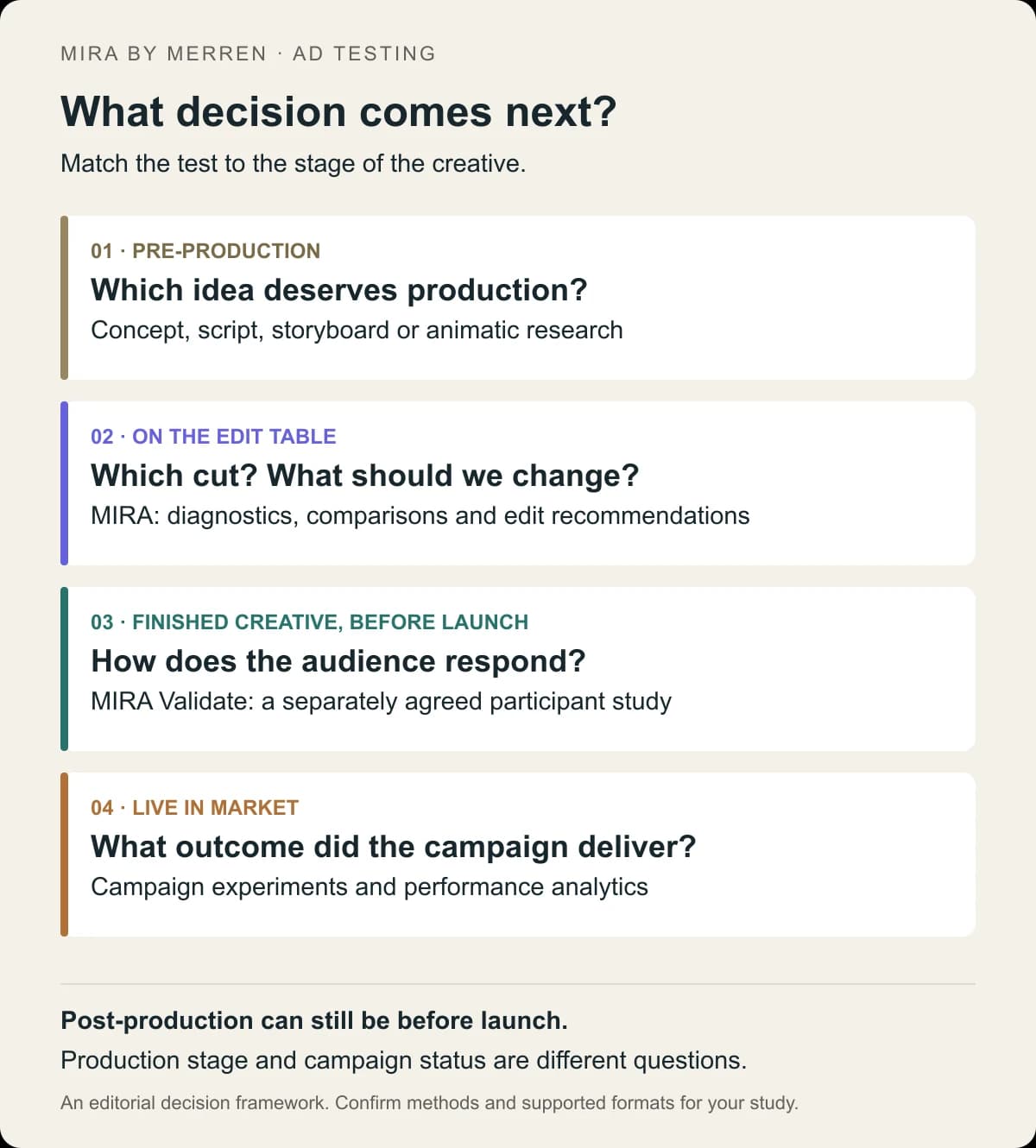
Pre-production, editing, post-production and post-launch testing
“Before launch” covers a surprisingly large part of an ad’s life. A storyboard and a locked film can both be tested before launch, but the changes you can make are very different. Keep production stage separate from whether the campaign is already running.
| Stage | What you have | Decision to make | Useful approach |
|---|---|---|---|
| Pre-production | Concept, script, storyboard or animatic | Which idea deserves production? Is the message understandable and relevant? | Concept research, qualitative interviews or a structured storyboard test |
| During production and editing | Rough cuts, alternative openings, edits or cutdowns | What should we select, keep, change or remove before locking the ad? | Creative diagnostics and variant comparison; MIRA for editable video creative |
| Post-production, before launch | Finished executions | How does the intended audience respond? Which finished version should proceed? | Audience validation; MIRA Validate, Kantar LINK+ or System1, depending on the study |
| Post-launch | Ads running with media spend | Which execution delivers the campaign outcome under the test conditions? | Campaign experiments and creative performance analytics |
Post-production ad testing means evaluating an ad after it has been produced. It can still happen before media spend. Post-launch testing happens after the ad enters the market. Confusing those terms can leave a team buying campaign analytics when it needs help choosing a finished film.
For true pre-production work, assess what the stimulus can communicate. A storyboard can help test the idea, sequence and message. It cannot reproduce a finished actor’s delivery, music mix or editing rhythm. A rough cut introduces those execution questions while there is still time to make useful changes.
Choose the ad’s objective before choosing its metrics
A new-product ad needs viewers to understand what the product does and why it matters. An awareness ad needs a useful memory connected to the brand. A performance ad needs to give its intended audience a reason to act, with the actual response assessed in market.
Sumit Saxena’s objective-led review guidance at Merren is to choose the metrics that help answer the ad’s question. Trying to optimize every available metric gives the team several competing definitions of success.
Engagement asks whether an ad captures and sustains attention. Comprehension asks whether viewers understand the story and message. Relevance concerns the connection to their needs; persuasion concerns the reason to choose or act. Affinity, distinctiveness, memorability and likeability each add a different perspective. An enjoyable ad can still leave the offer unclear. A memorable celebrity can still leave the brand forgotten.
Before commissioning a test, write a short decision statement: “We need to choose an opening that makes the new feature clear without losing the brand.” That is specific enough to guide the measures, the variants and the next edit. “Find the best ad” leaves too much unresolved.
MIRA: improve the ad while it is on the edit table
MIRA by Merren helps teams improve ROAS by selecting, editing and improving ads, comparing variants and benchmarking against their own ads, the overall ad pool or a pre-selected set. Its editing-stage role is practical: decide which version to work with and what to change before committing to the finished execution.
A useful workflow is to review alternative cuts, inspect the moments behind a diagnostic and give the editor a specific next action. An opening might need to communicate the product sooner. A brand cue might need greater visibility. A distracting scene might need shortening. Check whether the proposed edit strengthens the ad’s objective and what it might weaken.
MIRA’s video report includes a Creative Strength score and benchmark, modelled response over time, predicted visual attention and timestamped recommendations. Those outputs guide inspection of the creative. The methodology explains the evidence sources: modelled response is not a brain scan of viewers watching this ad, and predicted attention is separate from gaze collected from participants.
Use this stage while the editor can act on the findings. Comparing two openings is more useful when one can still be swapped into the film. If a change needs a new shoot, the team also needs to weigh its cost against the importance of the problem. Pre-launch diagnostics do not establish the ROAS a campaign will achieve.
MIRA Validate: test finished creative with an audience
MIRA Validate addresses the post-production question: how does the audience respond to the finished execution? It is Merren’s audience-testing offer for that stage, in the same buying conversation as established creative evaluation solutions such as Kantar LINK and System1. The methods and measures should be compared individually.
The MIRA Validate participant study is agreed separately with the Merren team. Define the audience, sample, exposure context, questions and available measures before commissioning it. Ask which outputs come from participant answers or recordings and which come from modelling.
For a product introduction, you might investigate what viewers believe the offer is and which brand they associate with it. For brand building, you might focus on brand connection and what survives after exposure. If participant gaze or facial response is part of the study, confirm the collection method and quality checks. A facial response does not, by itself, establish comprehension or purchase intent.
Keep the tested version identifiable. If the team changes the ending, voiceover or product claim afterward, record that change and decide whether it needs another check. The study describes audience response under its stated conditions; a later campaign experiment answers the question about market outcomes.
Ad testing software comparison: what each option helps you decide
Several providers support more than one stage. Kantar describes LINK+ testing from storyboards through final executions. System1 also offers early-stage testing. Shortlist a product for the particular research job; do not assume a provider is limited to finished-ad approval.
| Option | Main use in this guide | Evidence or output | Check before buying |
|---|---|---|---|
| MIRA | Selection and improvement of editable video ads | Modelled creative diagnostics, variant comparisons, benchmarks and edit recommendations | The reference set and the changes your editor can still make |
| MIRA Validate | Audience testing of finished creative | Participant evidence from the agreed study | Audience, sample, stimulus format, exposure context and enabled measures |
| Kantar LINK+ | Structured creative evaluation from early work to finished ads | Survey-based audience evaluation and creative diagnostics | Study design, format, audience and relevant norms |
| Kantar LINK AI | AI evaluation of supported video and static assets | Model-based predictions | Current supported channels and the evidence behind each prediction |
| System1 Test Your Ad | Early-stage and finished-ad evaluation across several media | Consumer emotional response, branding measures and benchmarks | The package, format, market and decision its measures support |
| Zappi | Structured consumer research, including storyboard testing | Audience feedback on the creative idea and execution | The appropriate solution and stimulus for your production stage |
| Maya by Merren | Qualitative exploration of audience interpretations | AI-moderated interviews and follow-up responses | The discussion guide, recruitment and depth of probing required |
| Motion | Analysis of creative performance after launch | Connected campaign metrics and creative reporting | Supported integrations, attribution and differences in delivery |
LINK+ and LINK AI are different offerings. Likewise, compare a System1 consumer study with the relevant consumer-study alternative, and an AI screen with the relevant model-based analysis. A shared label such as “ad testing” does not make their evidence interchangeable.
Ask for a quote against the same brief. Include recruitment, markets, number of executions, analysis and any retest. A subscription price and the cost of a recruited audience study cover different work.
Choose the test by ad medium and format
A television film, a vertical social video and a poster can carry the same campaign idea. Their viewing conditions change what you need to examine. Specify the medium, placement, duration or dimensions, sound conditions and intended audience in the test brief.
| Medium or format | Questions worth testing | What to include in the stimulus |
|---|---|---|
| TV, connected TV and cinema video | Does the story communicate the intended message? Does the audience connect it to the brand? | The actual edit and duration, with its intended audio |
| Skippable online video | What does the opening communicate before viewers can leave? Is the brand or offer visible when it matters? | The opening and full execution in the relevant skip context |
| Vertical social video, Reels and Shorts | Does the creative communicate at phone size? Are captions, the product and brand obscured by interface elements? | The placement’s crop, interface, captions and sound conditions |
| UGC, influencer and testimonial ads | What is the viewer taking away about the product? Does the featured person support or overshadow the message? | The complete execution, including claims and brand cues |
| Display, static social, print and outdoor | What receives attention? Can the message and brand be understood under the intended viewing conditions? | The actual layout, scale and realistic exposure context |
| Carousels and sequential creative | Does each card communicate something useful? Can the offer be understood if later cards are not seen? | Cards in their intended order and interaction context |
| Radio, podcasts and streaming audio | Can listeners identify the brand and offer without a visual cue? Is the call to action understandable? | The actual audio, including delivery, music and sound effects |
| Search and text ads | Does the message match the query and the landing page? Which version produces the defined campaign outcome? | The rendered text, query context and landing-page experience |
For editable video, MIRA can help investigate the film and compare cuts. For finished-creative audience research, discuss the exact medium and stimulus with the MIRA Validate team. Do not assume that support for video automatically includes an audio-only file, a poster or an interactive carousel.
Other providers also differ by format. Kantar describes broader LINK+ media coverage and static formats for LINK AI. System1 lists TV, social, digital, outdoor, audio and print. Match the specific package to the format you will publish.
A practical example: one campaign, several testing decisions
Consider a hypothetical launch for a new delivery service. The team plans a longer video, a short vertical cut and a static offer ad. The objective is to explain what the service does and give the intended audience a reason to try it.
Before production, research the concept and the promise. Can people explain the service from the script or storyboard? What do they find unclear? Maya interviews or a structured concept study can help explore those interpretations. A rough sketch should not be judged as if it were a finished performance.
On the edit table, compare two video openings with MIRA. One spends several seconds establishing the situation; the other introduces the service earlier. Inspect the diagnostics and the scenes behind them. If the earlier introduction makes the benefit clearer, check whether the edit also weakens the story or buries the brand. Name the change you want the editor to make.
When the assets are finished, use an audience-validation study to address the unresolved questions. The vertical cut and the longer film may need different exposure conditions. The static ad needs its own clarity and branding check; viewers cannot wait for a later scene to explain it.
After launch, evaluate the chosen campaign KPI with an appropriate comparison. If the short cut delivers more clicks, investigate whether those clicks produce the intended result. Changes in audience, placement or delivery can also affect the comparison. This example illustrates a workflow; it is not a report of a client study or a predicted outcome.
What to ask before buying ad testing software
Give shortlisted providers the same decision brief and one representative asset. Ask how they would answer it, what evidence you receive and what remains unresolved. You will learn more from that discussion than from counting dashboard features.
- Can the tool handle this production stage and this exact ad format?
- Who is the intended audience, and is the output based on those participants or on a model?
- Which measures answer the ad’s objective? What would change your decision?
- Can you trace a finding to a scene, participant response or campaign observation?
- Which benchmark is used: your own ads, a wider pool or a selected comparison set?
- What can the team still change, and does the result arrive before that deadline?
- What does the quote include, and what would a revision or retest cost?
Keep the asset version, decision and rationale together. “Move the product demonstration before the joke, then check comprehension again” gives the team a concrete action. “Make it more engaging” leaves the next reviewer to decide what that means.
Frequently asked questions
What is the best ad testing software?
The best ad testing software is the one suited to your decision and stimulus. Use concept research before production, creative diagnostics while editing, audience validation for finished assets and campaign experiments for live outcomes. MIRA and MIRA Validate address different parts of that workflow.
What is the difference between MIRA and MIRA Validate?
MIRA helps select, edit and improve creative while it is still on the edit table, using modelled diagnostics, comparisons and benchmarks. MIRA Validate is a separately agreed participant study for evaluating audience response to finished creative.
Is post-production ad testing the same as post-launch testing?
No. Post-production testing evaluates creative after production, often before launch. Post-launch testing evaluates ads already running in market. A finished-ad audience study and a live campaign experiment answer different questions.
Can I use the same test for every ad format?
The research objective can stay consistent, but the stimulus and exposure conditions need to fit the format. A sound-off social video, an audio ad and a poster give the audience different information and opportunities to respond.
Can AI ad testing guarantee ROAS?
AI ad testing can inform selection and improvement. ROAS also depends on the offer, audience, media delivery, landing page and measurement. Assess actual campaign outcomes after launch; a modelled creative score is not a guaranteed return.
Choose the next decision your team needs to make
If the idea is unresolved, investigate it before the shoot. If the film is still editable, use MIRA to compare variants and identify changes. When finished creative needs audience evidence, discuss MIRA Validate. After launch, use campaign results to learn what the execution delivered.
For a closer look at editing-stage evaluation, read our guide to choosing ad creative testing tools. If you are deciding what deserves approval, use the objective-led creative evaluation checklist.
Explore MIRA to review editable video creative, or speak with Merren about a MIRA Validate study for your finished ad. Bring the objective, the asset and the decision deadline so the test can help your team move forward.